
Turning Conflict into Competitive Advantage
High Performance through Engagement (HPtE) works on three layers:
| Layer | Name | In one line |
|---|---|---|
| The strategic narrative | The 3Cs Model™ | A strategic narrative every person in the organisation can understand — from the board to the shop floor, in the same three words. |
| The pathway | HPtE Strategy® | The route from where an organisation is now to synergy across all three Cs, in the order that works. |
| The mechanism | High Performing Teams | The right people, the right behaviour, the right process — the room where conflict is actually dissolved. |
Three ways to start
Learn the method in a single day, on a conflict you bring with you — add the half-day that makes your team self-sufficient in it — or open the strategy with a half-day for your leadership team.
The strategic narrative — The 3Cs Model™
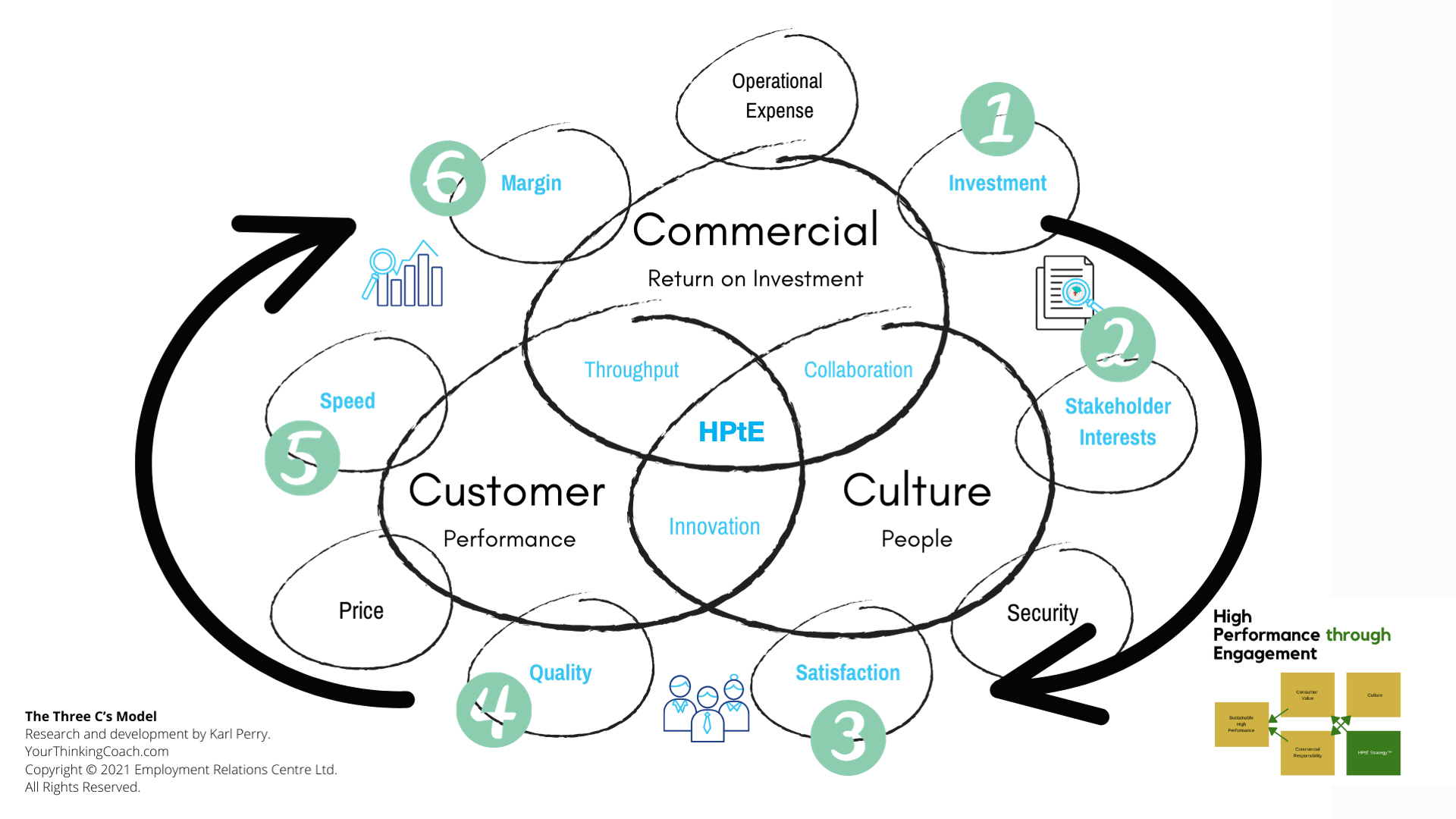
Every organisation needs to deliver three things at once: Commercial Responsibility (margin, investment, operational expense), Customer Value (quality, price, speed) and Culture (security, satisfaction and stakeholder interests). These are the 3Cs. Most organisations treat them as competing and then try to manage the trade-offs between them. This causes conflict between Finance, Operations and People. Traditional approaches to workplace conflict deal with the conflict after it happens. HPtE and The 3Cs Model addresses the conflict before it happens.
But the real power of The 3Cs Model is that everyone can understand it. A director, a shift manager, a union representative and someone in their first week can all hold the same three words in their head, see where their own work sits inside them, and recognise the moment two of them are pulling against each other. No glossary, no cascade deck, no translation for the front line.

The tension is the point
Picture a three-legged stool. The thing that makes a three-legged stool work is the tension between the three legs. You don’t want to remove the tension between the legs or the stool will collapse. If you want to strengthen a three-legged stool and make it more resilient you need to tie the legs together with a piece of wire.
Most initiatives treat the tension as a problem to get rid of. That works to a point. But, remove the tension and you do not get a stable organisation. You get one where the same forces still pull and nobody is permitted to say so. The conflict returns.
HPtE does the opposite: it harnesses the tension rather than removing it. Surfaced, worked properly and held long enough, the tension between the three Cs is the most reliable signal an organisation has about where its next improvement is. That is the key to high performance.
HPtE is the wire.
Where the legs meet
The value is not in the three circles. It is in the three overlaps — the conflict zones. Each has two possible outcomes, and which one an organisation gets is a matter of how it works the zone, not how hard it tries.

| Conflict zone | Working | Failing | How the failure shows up |
|---|---|---|---|
| Zone 1 — Industrial conflict Commercial ↔ Culture | Collaboration | Conflict | Disputes, grievances, industrial action, adversarial union–management relations |
| Zone 2 — Departmental conflict Culture ↔ Customer | Innovation | Silos | Departments optimising their own metrics, failed handoffs, blame when they fail, managers and employees wasting valuable time dealing with conflict |
| Zone 3 — Operational conflict Commercial ↔ Customer | Throughput | Waste | Cost-cutting that damages service, rework, revenue lost to slow cycle times, productivity initiatives stalling |
All three failing at once is systemic conflict — the flame at the centre of the model, and the cost every organisation pays whether or not it is measured.

Conflict is not the fault in the system. It is where the next improvement is hiding. That is what the HPtE Strategy does.
The pathway — HPtE Strategy®
High Performance through Engagement is what you do with the model. It is the route from wherever an organisation is now to synergy across all three Cs, taken in the only order that holds.
| Order | Zone | What happens |
|---|---|---|
| First | Zone 1 — collaboration | Trust and safety before anything else · management and union in the same room · nothing else works while this is live |
| Then | Zone 2 — innovation | People contribute once it is safe to · boundaries between functions come down · customer value improves from the front line |
| Then | Zone 3 — throughput | Velocity, waste and margin · improvement now serves everyone’s interest · the commercial return compounds |
The mechanism — High Performing Teams
A strategic narrative and a pathway change nothing on their own. The work happens in a room, with a team, on a real conflict. Three things have to be true in that room at the same time — get all three right and conflicts that have sat unresolved for years dissolve in hours. Miss any one and nothing changes.
The right people
- Managers with the authority to decide
- Union representatives with a real voice
- Subject matter experts with the knowledge and the data
Who is missing from the room is usually why it is stuck.
The right behaviour
- Constructive behaviour, defined and agreed
- Leadership that holds the space
- Ground rules everyone in the room owns
Agreed by the room, not imposed on it.
The right process
- Accelerated interest-based problem solving
- Thinking tools that surface the real constraint
- AI support that speeds the reasoning, not the judgement
This is what your own people take away and run again.
How it starts
You already know where your conflicts are. They appear in the same meetings, between the same functions, on the same issues, year after year. HPtE builds your own people’s capability to dissolve them — and High Performing Teams is where that happens.
It starts with the company leadership, because they are the sponsors. Each of the first three sessions ends in a single decision, and nothing moves until that decision is taken.
Company leadership
The sponsors. A deep dive on The 3Cs Model™ and HPtE Strategy®, an assessment of your Conflict Tax, and a first list of candidate Proof of Concept projects.
The strongest candidates are the initiatives already scoped, already started, and stuck. The value is agreed, the work is underway, and something is holding it.
The decision: whether to extend an invitation to the Union.
Union leadership
The same deep dive on The 3Cs Model™ and HPtE Strategy®, run in full, by the same third party. What changes is the focus. There is no Conflict Tax assessment here — the union’s stake is security of employment and terms and conditions for member employees, the interests any change on the table has to satisfy.
Their list follows from those: the projects where a way through has not been found yet. In safety-critical industries there is a second option — safety as a joint stakeholder interest, one both sides already hold.
The decision: whether to take part in a joint session.
The joint session
Two lists on the same table for the first time. The overlap is the interesting part — the same project, named by both sides, stuck for two different reasons.
That is a conflict with its evidence already attached, and both sides already agree it is not moving.
The decision: whether to enter into a Proof of Concept, and what it is.
Terms of Reference for Proof of Concept
A working session that produces the document itself: the problem as both sides state it, the team that will do the work, the scope and its boundaries, what a result looks like, and how it will be measured.
Nothing is left to interpretation afterwards. Both sides leave with the same document.
The output: agreed Terms of Reference, owned by both sides.
The High Performing Teams Workshop
Not everyone arrives through a boardroom. The workshop is the open door: one full day, all three layers — The 3Cs Model™, HPtE Strategy® and High Performing Teams — for anyone who wants to learn the method rather than commission it.
The strategy and the pathway
The 3Cs Model™, the three conflict zones, and the order in which they have to be worked — the first two layers, taught in full.
Nothing held back for a later module.
The mechanism
High Performing Teams: the right people, the right behaviour and the right process, as set out above. Each one is taught and then run on a live conflict.
This is the half you will use on Monday morning.
Anyone in the room
Managers, union representatives, HR and IR people, and independent practitioners. Mixed rooms are welcome — the method is the same whichever side of the table you sit on.
It is also the first step towards becoming an Accredited HPtE Practitioner.
You practise as you learn. Bring a conflict you are carrying: you learn each tool by using it on that conflict rather than on a case study, and you leave having worked it rather than having watched it worked. Your own problem is the training material.
The Rapid Improvement Process — and AI
The workshop teaches the method. This is the half day that makes a team self-sufficient in it — an add-on to the workshop day, or a session on its own for a team that has already done it.
The Rapid Improvement Process is the everyday form of the method: not a conflict-resolution technique but an assumption-revealing one. Worked properly, a conflict stops being noise and becomes diagnostic data — what each side is protecting, why both positions look reasonable from the inside, what outcome both are actually serving, and which single assumption makes the two appear mutually exclusive. Remove that assumption and the conflict dissolves.
Start by counting the stakeholders
The first move is always the same question. One stakeholder is a decision someone is stuck inside. Two is a conflict between parties. Multiple is the human system itself — rules, policies, beliefs and behaviours.
The same process at every scale, so the room sees one method scaling rather than three different tools.
The count sets the scale — and the conditions the process needs.
Demonstrated, then handed over
The process is worked live first, thinking aloud, so you see the moves before you try them. Then you pair up — one coaching, one bringing a real problem — and work it a step at a time, the room coming back together after each step.
The group then works a positional conflict together, and finishes on the enterprise form: the same process with a team of subject matter experts.
You leave with the template and the practice, not the notes.
Where AI comes in
An introduction to accelerated interest-based problem solving: interest-based problem solving, the thinking tools that expose which assumptions are holding a conflict in place, and AI support that speeds the reasoning, not the judgement.
Work that took days of facilitation can be worked in hours — by the people who already hold the context.
The judgement stays with your people. It has to.
Why it sits after the workshop. The workshop day gives a team the strategy, the pathway and the mechanism. The question that follows it is always the same one: how do we keep this going when there is no facilitator in the room?
This half day is the answer. A portable process, a template your team steps through itself, and a problem each person commits to running it on next.
Bring a live problem, as before. Not a case study — something from your own week that has not moved. That is the training material, and the result is yours to keep.
Then what
Everything after the Terms of Reference is a pathway rather than a course, and it is built to hand back. You practise as you learn — on your own live conflicts, from the first session to the last.
Proof of Concept
High Performing Teams training, applied immediately to a real conflict. One intact team made up of company, union and subject matter experts, its own co-leads, and a project from the shortlist — one already scoped, already started, and stuck.
The team learns the method by using it on its own problem and keeps using it, so the capability and the result build together.
A result you can take to your board and your members, with your own people co-leading it.
HPtE Leadership Team
We help you establish it, chair it and hand it over. The chairing is designed to end: once your own leadership team is running it, our involvement stops.
Consultant dependency is the failure mode, and a self-terminating engagement is the safeguard against it. Supervision afterwards is a choice, not a dependency.
Your own practitioners
Your HR, IR and Union Reps accredited to run this without us. They stay in practice on live work throughout, which is how the capability becomes yours rather than ours.
The end state: your people, your method, running without us.
We step away when two things are true: your HPtE Leadership Team is running the work, and at least one of your own people is an Accredited HPtE Practitioner.
From that point we support only if you ask. No standing involvement — supervision for your practitioners and their HPtE Leadership Teams whenever it is useful to them, and nothing when it is not.
The engagement is built to end. The relationship does not have to. Accredited HPtE Practitioners join the HPtE Community of Practice and keep access to it for as long as they want it — the method goes on developing, improvements reach the people using them, and there is peer support from practitioners working the same problems in other organisations. Independence from the facilitator, not isolation from the practice.
Where do you come in?
The same strategy, the same pathway and the same mechanism, entered from three directions.
| Route | What you get | Where to start |
|---|---|---|
| Organisations Performance you can bank | You are carrying a cost that does not appear on the balance sheet, and the conflicts generating it keep coming back. Discover it, work with it and deliver high performance across all 3Cs. | Organisational Leaders Dissolving the Conflict Tax |
| Unions Influence, not compliance | Representatives shape decisions at the point they are formed rather than objecting after they are made. Real strategic influence as the voice of member employees. | Union Leaders Winning Strategic Influence |
| Practitioners A method you can carry | HR, IR, Union Reps and independent practitioners. Learn it, apply it to your own live conflicts, stay in practice, and become an Accredited HPtE Practitioner. | Practitioners Who Transform Conflict into High Performance |
Start a conversation
Just add your name and email address. That is all. We will come back to you to arrange a short chat — nothing to prepare, nothing to fill in.
Thank you for your response. ✨
High Performance through Engagement is also written as HPHE (High Performance High Engagement) or HPE — the usual names in New Zealand, where the approach has been used at Air New Zealand, KiwiRail and in the Ports of Auckland transformation. The initials differ; the strategy, pathway and mechanism set out above are the same.